“On Monday, she got the call that they were being shut down.” She couldn’t believe they’d finally done it.
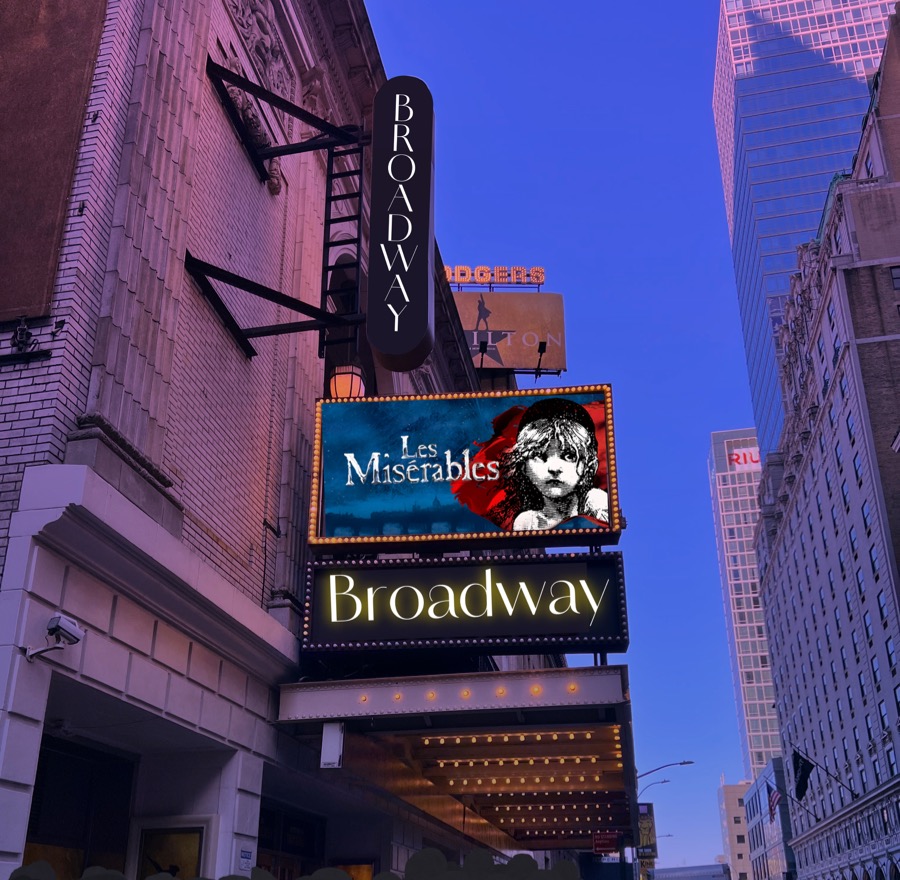
All she could do was stare at the musical posters clipped to the wall. Her temple buzzed and the cellular device connected to her optic nerve projected the WeNews newswoman from Channel 24 into her brain. “Today is May 25th, 2087,” she reported, “I am coming to you live from outside the Broadway Theater where the last human written, human performed show has officially been shut down to make room for the latest WeAct production. Les Miserables’ 100th Anniversary Broadway Revival began rehearsing in late October, opening to the public just two months before the WeDo robots hit the market, starring Dean Isly as Jean Valjean, Anna Tibben as Fantine, and Aaron Stophitz as Marius. Despite massive ticket sales, the production had only been running for four months before this shut down. As of right now, Broadway is completely AI.” The light died in the newswoman’s artificial eyes as the broadcast was shut off. She glanced at the window, at the artificially made advertisement for pet food that danced across the windows of the chrome building across from hers.
There were no more humans left on Broadway.
The thought of that sentence bubbled the acid churning in her stomach. She buried her hands in her face, feeling hot tears, stinging her eyes and flooding her cheeks.
A ringing burst into her ears. Her head shot up and she tapped her temple. There was a click as she answered the call and Aaron Stophitz’s voice filled her head.
“Have you heard the news?” he asked, his voice shaking a little. She nodded her head. “They can’t do that, can they?”
“They just have,” she replied weakly. Aaron paused, she could hear him hum to himself as he thought.
“We have to do something,” he said, his voice stronger than before. Anna blinked in disbelief.
“What can we do?” she asked. The idea of action sounded intriguing, but the people who ran the theater had billions of dollars. They didn’t care about the feelings, or incomes, of the poorer actors they’d put out of jobs. Aaron paused again to think.
“What about we boycott Broadway?” he asked, starting to list off ideas.
“We can’t afford to go to Broadway in the first place,” she answered, flatly.
“We convince people to stop going to Broadway?”
“The only people we’d reach are people who are already boycotting Broadway.”
“What if we block off Broadway?” This idea sat in the air like a bomb about to go off. The words caught Anna off guard.
“Like in Les Mis?” she asked, raising an eyebrow.
“Exactly,” he said, she could hear the smile creeping into his voice and the idea being thought out as he said it. “We could block the entrances to all the theaters so people can’t get in and see the shows.”
“But won’t people just complain and ask for a refund?” Anna asked. The plan was intriguing, she had to admit, but it sounded impossible.
“Exactly,” he shouted, rattling the implant in her right temple. “If tens of thousands of people ask for refunds, that’s billions of dollars in refunds and billions of dollars that’s lost everyday we barricade. Then they’ll have to rehire us!”
“Don’t most of the characters in the show die because of the barricade?” she asked, recalling the endless hours of fight choreo for just a five minute battle scene. She was trying to ignore his enthusiasm, and in turn the hope building in her own chest. Hoping for change wouldn’t do anything.
“Yes,” he admitted. “But,” he added, quickly. “That was over politics and was set in the 1800s. This is about Broadway and is set in the 2080s. No one is going to kill a bunch of actors over a couple of theaters.” She nodded to herself slowly, thinking about the proposed idea. She had to admit, it was tempting. She thought back to opening night, to the four months of shows that she had people coming up to her telling her that they looked up to her and that they longed to be actors too. She thought back to the kid she used to be, watching illegal recordings of shows online before bed, dreaming of being on the stage. As she thought about the kids who’d have to grow up watching robots on the stage where human actors should’ve been, something shifted inside of her.
“If we’re going to do this,” she said, plainly. “We’re going to have to do it in a way where a lot of people know, but no one big enough to shut us down knows.” Aaron’s face lit up.
“I have so many actor friends,” he explained. “I’ll tell them to spread the word!” Anna smiled.
“I’ll tell the cast,” she said.
Nearly 17,000 actors, crew members, and humans passionate about the arts from all over the world met in Central Park at 8:00 AM on Thursday, June 5th, 2087. Anna and Aaron stood in front of the crowd holding megaphones with projections of the words they were saying being shown above their heads.
“WE ARE ALL HERE FOR THE SAME REASON,” Aaron’s voice boomed across the park. “TO STAND UP FOR OUR ART AND THE ARTS EVERYWHERE!” The crowd roared and clapped.
“FOR THIS TO WORK,” Anna added. “WE’LL NEED ABOUT FOUR HUNDRED PEOPLE PER THEATER. BLOCK ALL PUBLIC DOORS TO THE THEATER AND LET NOBODY IN! WE WON’T MOVE UNTIL THEY PUT HUMANS BACK ON BROADWAY!” The crowd cheered again. Anna glanced at Aaron.
“DO YOU HEAR THE PEOPLE SING?” They started to sing.
“SINGING THE SONG OF ANGRY MEN!” The crowd started to join in.
“THIS IS THE MUSIC OF THE PEOPLE WHO WILL BE ON STAGE AGAIN!”
The crowd started to march. They didn’t march for long. The theaters weren’t far away. But it was long enough that various news stations had already caught on and had already positioned themselves on the streets when the crowd arrived. When they reached the theater district, parts of the crowd split off to block various theaters. Former Broadway performers clad in old news boy’s hats and old costumes, some holding prop pitchforks and torches, flocked to their old stages. Former film actors followed the former Broadway stars they looked up to and vice versa. They packed themselves under each theater awning, each displaying posters of the robots that’d replaced them. Old friends reunited in front of the theaters they’d seen their first show in, and the cast of Les Mis blocked the doors to the Broadway Theater.
The crowds still sang as they moved to block the different theaters. “WHEN THE BEATING OF YOUR HEART!” Their voices rang out through all of New York. “ECHOES THE BEATING OF THE DRUMS!” Thousands of people standing up for the craft they love and the art that has built who they are. “THERE IS A SONG ABOUT TO START!” Every actor, young and old, Broadway or screen, ensemble or lead, “WHEN TOMORROW COMES! DO YOU HEAR THE PEOPLE SING?” sang their plea to the sky, to the producers, to the directors, to the theater gods – and the whole world heard their message.
At around 8:00 PM, the streets grumbled with hungry stomachs and humans who missed their beds. People still stood and sat in front of the theaters, but the enthusiasm had been gone for hours. Those who’d brought food and shared now sat with empty stomachs. Suddenly, an eighteen wheeler truck stopped in front of the theater. Anna and Aaron jumped to their feet and stared as the vehicle tried to park in front of the crowd. “Do you think it’s-?” Aaron started to ask quietly. Anna stared at the truck.
“Maybe,” she replied. The car door opened and a man stepped out. The man was very old but seemed very nimble. Anna squinted. “Holy cow it’s Lin Manuel Miranda!” she shouted.
“I didn’t think he was still alive,” Aaron muttered as he followed Anna to help the old man to the sidewalk.
“I brought supplies,” Lin Manuel Miranda said, wheezing a little with every word.
“Thank you so much, Mr. Miranda,” Anna said, she watched him fumble with his pocket until he finally produced a key. He handed it to Anna.
“Here,” he said. “Feed the actors.” Anna took the key and he turned, quicker than any man should at 107 years old and started walking briskly in the direction of Washington Heights. Anna and Aaron stared at each other, and at the man who’d just walked away.
“Should we open the truck?” Aaron asked, glancing at the truck that’d been parked in the middle of the street.
“I guess,” she answered. They made their way around the truck and pulled open the door to reveal boxes of wrapped sandwiches and burgers, chips and cookies. In the back, was a very tall stack of boxes full of tea. Anna’s mouth dropped open.
“We have to tell everyone!” Anna and Aaron shouted at the same time.
With the help of the Les Mis cast, Anna and Aaron distributed the food among the striking actors. One after another, representatives from each of the theater crowds approached the truck and returned to their group with an arm full of food and a Les Mis cast member or two also carrying things. Thousands of people slept on the streets with food in their stomachs and boxes of cereal for morning.
At 10:00 AM the next day, the actors got word that the producers were conferencing. “We might’ve done it,” Aaron cried.
“Don’t get your hopes up,” Anna warned.
After an excruciating four hours of waiting, everyone’s cellular implants buzzed at the same time. Anna tapped her temple and the WeNews newswoman from Channel 24 filled their vision, this time sitting behind a desk
“BREAKING NEWS,” she announced. “After a grueling four hour meeting, the executive producers of Broadway have agreed to replace every android with a human actor. To quote the protestors, themselves, the executives have heard the people sing and there is a song about to start when tomorrow comes.”
Broadway was human again.
Leave a Reply