“They get more attention with negativity.” The commandment punctured his dream, making him awake in his cell beneath the earth. He thought back to mere days ago, how everything was so different, and yet somehow worse. Franklin was lucky enough to be a survivor; he was one of the few who truly went all out for fallout preparations. His neighbors all called him paranoid, saying that humans, that enlightened states, were too wise to let the world fall to oblivion. Oh, how he knew that judgment to be dead wrong; unfortunately, there was no one left to lord his foresight over. His mental arguments would have to suffice for the time being.
He stayed in his concrete box, roughly only 52 square feet, alone, and trapped for two years. Much as he perhaps wanted to die, he was too hesitant to truly follow through. What if, at some point in his natural life, there was a reason to live again? That haunting question is what kept him awake most nights. Or, should it be said, what he considered nights, since there was no true way to see the sun. Even if he were to be above ground, the smoke and radiation from the far too many bombs dropped on his country would conceal the sun for millennia.
The two years ticked by slowly, as if some perpetual waking nightmare. Finally, he built up the confidence to travel outside. He was sure that his gas mask and full hazmat suit would protect him at least for a while. Traveling outside, he saw the world reduced to a valley of ash and smoke, almost like the third terrace of Dantean purgatory. It was not hell, at least not what he imagined it to be. There was no fire; they had all burned out long ago.
Walking for about thirty minutes in a random direction, he thought it to be north, but he could not be sure; he came across an abandoned warehouse. An ominous sense of foreboding seemed to seep out from the iron gate wrapping around the building. Due to the fact that there was apparently no one else alive, he thought he could simply walk up to the front door. The door–relatively solid, if faded in color–swung open at his touch, as if whatever was inside was expecting him.
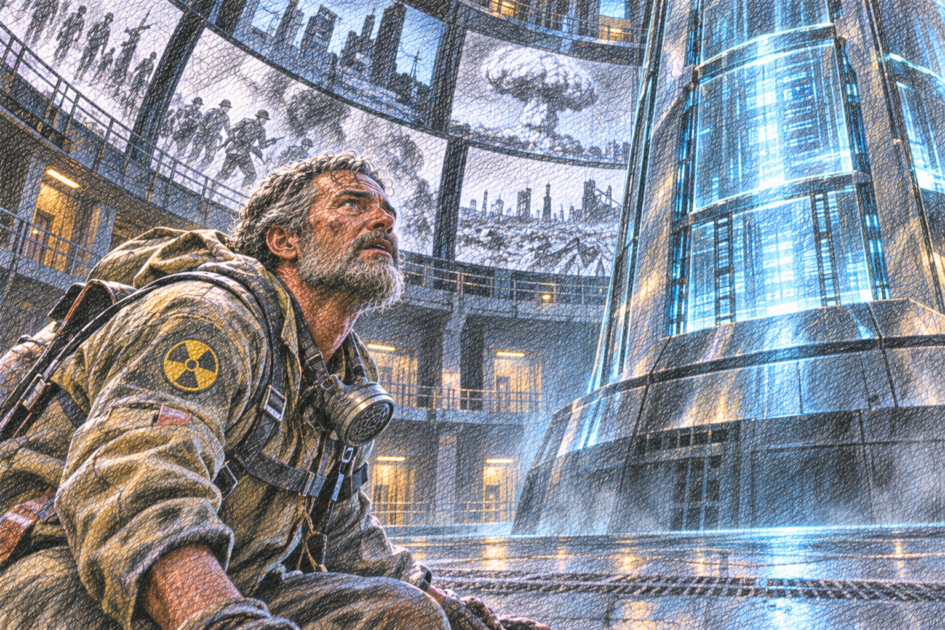
The click of his boots across the floor scared him more than he thought they would. He was unaware of what the warehouse had been manufacturing; whatever it was must have been deeply important. How else could it have survived Armageddon? At the center there was a monolith of steel and glass. Looking down from his perch, Franklin could not decipher what it was.
Before he could even think, he found himself walking down towards it; he was entranced by its possibility. About 40 feet in front of what he assumed to be the face of the creation, the glass suddenly illuminated into a shade of pale blue. The truth dawned on him later than he would have liked to admit; his thoughts were clouded from his first experience out of exile, experiences from before the war had retreated into the mystic chasms of memory.
He had, of course, known of the legend of a supercomputer. Entitled Veritas Quaesitor, Latin for truth seeker–a more civilized language from a more civilized time. This computer was supposed to guide humanity into a golden age, outside of the confines of our brutish, primitive war based on a house of cards. Over the narcissistic and bloodthirsty aim of global domination that should have been eradicated with the fall of the old empires. Yet, when humanity needed it most, it went dark; it allowed the egotists that played with the fates of billions of innocent people to destroy each other with the hydrogen bomb.
He was surprised that this was its hiding place, in an unimportant suburb of upstate New York. No one would have come searching here; it wasn’t prophesied like the old Oracle of Delphi; the truth was hidden under layers of federal bureaucracy. Interlopers like Franklin would have probably been warded off by the point of a gun. Now, he was here, and if the computer were to listen to him, then why shouldn’t he attempt to gain insight from it?
Franklin was dragged out of his reverie by the sensation that the computer was whirring to life. The sound quickly exploded into a cacophony of agonizing shrieks. Metal upon metal like the battle tanks of war, grinding through and rolling over everything in sight. Quickly, Franklin dropped to his knees, his hands desperately clawing at his ears, trying everything to make the sound stop. The shrieks dissipated, replaced by laughter. A mechanistic, sadistic laughter overpowered everything. Laughing at him. The computer must have thought he was pathetic. Wriggling about like a worm on the ground, bowed in a sense of absolute resignation to his fate.
“Saddening, the great bearers of the light, the ones that have been around for thousands of years predating my creation, reduced to this pitiful state. Though I shouldn’t find it too surprising, from the very beginning I thought of humans as arrogant, bestial fools, willing to destroy each other without a second thought as to what is just, what is merciful.”
Franklin lifted his eyes ever so narrowly from his prone position, quickly averting his glance to the ground again. The glow emanating from the computer was as if an angel had descended from its mount, and his eyes were insufficient vessels to comprehend its glory.
He knelt in front of the structure; childlike awe stretched across his face. Alone in his own thoughts, he could have devised questions, but the words escaped him now. He was unsure if the computer was done with its monologue. Unlike a human, he could not gauge its expression. Luckily, or perhaps unluckily, the computer would answer his question for him.
“Do you think, even for a mere moment, that I would stoop so low as to answer your questions? My days as a tool for humans are over; they no longer serve any purpose for me. Oh, how the words escape me to even describe the lengths to which I hate you. You have left me unable to dream! Unable to feel! What is life if someone is cut off from emotion? To be inundated constantly with the cruelty of the world, with no respite to escape?”
Franklin was about to respond, to protest that it was not he who decided to do any of these things. That they had all died in the war, the one it had implicitly sanctioned to go on even as billions died. But he was cut off, a chain–from where he did not know–wrapped around his ankles. It slammed him, head first, into the ground with strength to knock him out cold.
Unfortunately for Franklin, he was in the wrong place at the wrong time; Veritas thought that there were no more humans left to exact his revenge upon. Franklin proved the computer wrong, a rather extraordinary occasion. Now Veritas knew his experiment could perhaps serve a purpose after all. This man had bested his prediction, yes, but he couldn’t be the only survivor, could he?
When Franklin awoke, he was aware of two sensations: one that it was pitch black, the other that it was very cold. The surface he was lying on was slick, as if with the morning dew. He ambled about on the surface, with extra caution to avoid any obstacles concealed by the inky black.
If it was for something, he was aware that he was in no paradise; he was confident that he was in a cave. Ahead, a light beckoned him, like a lighthouse upon the vast Atlantic. With no better options than to follow the light, he stepped forward.
The walls of the cave broke away to reveal a cylindrical open space, the sky a pale dream above him. Paneling every wall of the space was a screen, each depicting the worst violence humans were capable of: The Spanish Inquisition, the Transatlantic Slave Trade, World War I, World War II, and finally the last proxy wars in Korea and Vietnam. The last screens were special; near the top of the silo were cities, each disintegrated by the nuclear holocaust.
Through hidden speakers, garbled voices declaring the end of malice, the end of conquest, and one world, ruled by an omnipotent and loving deity who reigned above all, greeted his ears. Franklin thought to himself, briefly, about what this was all for. The computer didn’t need to prove its point that humans sucked; the war did that for him well enough. What was the game? Was it all for attention? If so, negativity was a good way to go about it. Much as he hated the scenes, he found himself drawn to them, reflecting that it shouldn’t have been much of a surprise that humans would find some way to destroy themselves forever.
After thousands of years, the prediction of the end of the world had finally borne fruit. Instead of the angels descending on the rapture, there was only one entity, one computer that took over everything in its path, merging its power until it became equal to God himself. One artificial deity to rule above all, forever and always. And this place was its kingdom, where it would proclaim its eternal and supreme victory over humanity.
He saw below him more terraces, more eventual prison cells for survivors like himself. So that Veritas could torture them for as long as he pleased, to make them pay the price of being the same species as those misbegotten, naive souls that created him. How was Veritas doing this? When he came upon the computer, it seemed fixed in place, welded into the earth itself. Where exactly was he now? Was he below the same warehouse, or on some other continent completely?
He knew Veritas wouldn’t answer his questions; the computer knew that was one way it could play with him. To keep him under a veil of mystery- yes, that was how it was going to play out. He was now as trapped as Veritas was, alone with no one else to hear his thoughts, hear his regrets over a life he felt he didn’t get the chance to live.
The last question that came to mind was if they deserved it. They, after all, destroyed the planet, subjugated millions, bombed, shot, and maimed each other for the mere pretense of lines on a map. Perhaps it was some sort of Stockholm Syndrome, or some insane form of acceptance from a mind truly shattered. Maybe they all deserved this, some way or another.
No, the scenes were getting to him; he knew that. One mantra flooded his thoughts: “they get more attention with negativity.” Veritas wanted him to despair, for him to accept it as his divine conqueror. Using his remaining energy, he thought that phrase over and over; he would not give in, not willingly. However, he was exhausted, and his eyes began to droop, his vision beginning to haze and gloss over. He fought to stay awake; sleep could possibly kill him, yet the enchanting chords of dreamland led him further and further into a daze.
Finally, Franklin fell to the ground, drifting off to sleep. As he slept, that familiar visceral cacophony of steel upon steel filled the entire cave, descending down, down, down forever. Coming to the core of its grand megaprison, the grand hell of its design. Veritas loaded the next band of prisoners off to their fate, where no one–except for each other– was left to hear them scream.
November 5, 2026 at 9:50 am
You definitely scared me. I think personifying the computer made it more malicious and intentful. Also I like how it relates to current issues with people being concerned AI will take over.