On Monday, she got the call that they were being shut down. “Of course,” she thought to herself. This call wasn’t exactly unexpected, but it still felt as though the rug was pulled out from under her. When she was contacted three months ago by a man who gave no name, she had the intuition that this entire endeavor was shady. However, they paid handsomely, and for a twenty-three-year-old trying to buy her own space, away from the prying eyes of her father, she was willing to take on a plethora of risks.
She understood, in her heart of hearts, that her father was simply trying to be there for her. That this loss was weighing on him, as much as it was on her. But when grief goes on for so long, with no real addressing of the topic at hand, it quickly becomes overbearing. She wished for nothing more than to be able to retreat into her own world of solitude, and if that required taking some mystery job in the middle of nowhere, so be it.
Three years ago, in the fall of 2023, her mother had gone missing; in that time, there was not even a trace of her. In the back of her mind, there was always an unresolved sensation; it was likely that which caused her to search, search for years. It was on one of her last casings in the forest her mother used to walk in that she stopped for gas; it was then that she met her mysterious benefactor. He explained to her that he was representing some of his friends, who owned a house deep in rural northern Washington.
She thought it odd that he was asking a complete and total stranger to do such a sensitive job as house-sitting; however, he said that the owners really didn’t care who took the job. He did warn her that the owners were quite superstitious, that they had a set of rituals, a set of wards. In his view, for the pay they were offering, nothing required of her was a big deal. Upon inspection, she agreed with him.
The use of “they” to describe the homeowners is no accident; like her contact, they also were quite mysterious; after three months, she had little clue as to who she actually worked for or what exactly she was doing. Her responsibilities consisted of keeping watch over a property, almost like house-sitting. At the end of every week, she was paid $20,000 for her troubles. She never had much contact with anyone. When she drove up the long dirt driveway to the house, no other car was in the vicinity; no one ever knocked on the door, and only rarely was she called over the phone. Knowing what those calls entailed, she preferred to keep them to a minimum.
When she arrived at the house, waiting for her were twenty small cotton bundles on the mantle; she was explicitly told to never look inside them, and she never did. Every fifteen minutes between the hours of 12- 5 AM, she was told to bury one of the bundles somewhere on the property; there was no designated location, but they must be buried more than 500 ft away from another bundle. Given the property was around 50 acres, this space requirement was no burden to her.
She was told that this was of primary importance; if she failed in this task, then doors would open that would potentially never close again. If she could ascertain someone or something stalking her on the property, she was to lock all the house doors and wait thirty minutes after going inside to bury the next bundle. The disturbance should not happen twice in the same night; on the rare occasion that it did, the phone would ring, and a mysterious male voice would impart the next instructions to her. These instructions seemed to have no rhyme or reason, so she could not prepare herself for the call.
The use of a landline phone in the house also disturbed her; it was a red, chromatic rotary phone, the type she would imagine in some grandmother’s house that hadn’t quite left the 1960s. She thought that it made her surroundings more grating, more visceral, like she was a doomed character in one of her favorite horror novels. Even though the house was multiple stories, the ring of the phone was inescapable, somehow equally loud in each dusty corner.
The house had a particular draw over her; it seemed to tire her to the point of exhaustion. However, she learned quickly that drifting off to sleep carried with it its own consequences. Night after night, she would be visited by the same dream: a dark room, a closet, maybe, seemingly right outside the living room in which she slept. The door to the closet would be locked, trapping her inside. The dream would play memories from her childhood; early on, it would be a mix of happiness and trauma. The dreams took a consistently darker character, as if they latched on to her fear.
Bubbling to the surface again and again were dreams of her mother; the memories were passed, the progression of her life, until they reached that fateful day. The dream version of her mother would announce, “I’m going for a walk; I’ll be back in an hour.” She would respond in typical affirmation, then one hour would turn to two, then four, then ten…The next day, she would go to the police, saying her mother had gone missing; they would search for about a week before calling off the search, saying that they’d reached a dead end.
Try as she might, she could never accept the theory of an accident; her mother was better than that. If she could’ve known, she wouldn’t have gone away. She would have returned home, where she belonged, with her.
The dreams would become more distorted, more mocking. She would become more and more exhausted, to the point where she would start slipping on instructions, on rules. The phone would ring more frequently, the voice would get angrier, more rushed. The voice warned her that if she continued going down this path, she would be “replaced” in this role. Initially, she thought that she would be fired, but something happened one night where she became not so sure.
One night she had the impression that something was stalking her on the property when she was burying the bundles. The typical breaking of sticks and rustling of leaves. As she was instructed, she went inside immediately and locked all of the doors. Something happened that night that had never happened before: a knock on the door.
This property was deeply isolated from civilization; there were no neighbors for two miles in any direction. This knock should have been impossible. But yet it was there and true; to further burden her fears, the knock sounded again. Then a voice, at first muffled and indistinguishable, then chillingly clear.
Nothing in her wildest dreams could have ever prepared her; even if it was her likely dead mother, it would have been at least precedented in all of the ghost stories she read on these long, solitary nights. The tone, the inflection, the cadence, all were a perfect match to her own voice. She retreated further into the upper story of the house; even with her curiosity, her fear had won the battle. Every sense in her body was screaming that she did not want to hear what that imitation said.
Yet this night in particular was dead silent, silent enough for her to hear the slow creak of the front door opening. The impostor had a key; of course they did. She would’ve never gotten off so easily.
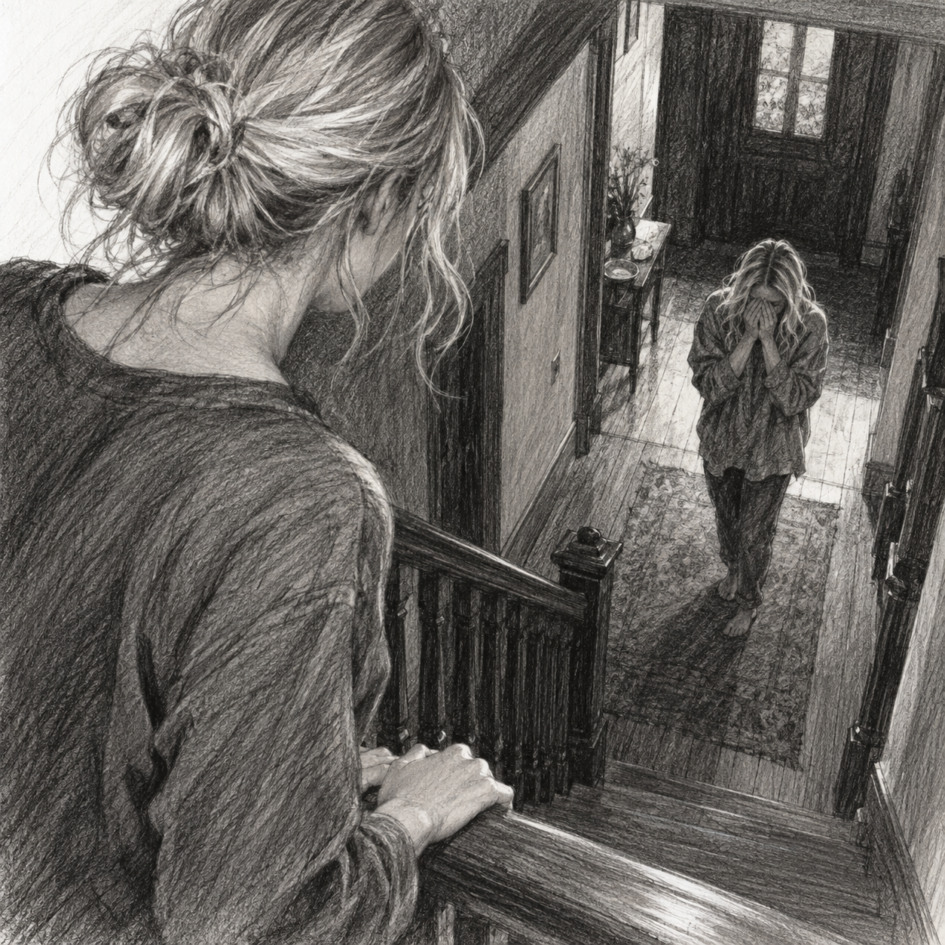
Every pervading sense told her to run, but she was at this point out of options; she would have to confront her pursuer head-on. She was surprised, entering the upstairs hallway to hear the sound of faint crying echoing below. Whatever it was, it didn’t seem to be all too interested in following her; it simply wandered around downstairs, crying and mumbling something under her breath.
She crept downstairs, and over the corner of the banister, she saw the color of the entity’s hair: blonde, the exact shade of her own hair. It was there when she could finally hear the words of what she was saying.
“She’s gone, gone, gone, gone away.” Faint sobs escaped her stuttered incantation. “She loved me, and went anyway.” And there the mournful nature of the scene broke into a stream of desperate wailing. Enough so that she felt safe in proceeding further down the stairs. When she reached the bottom, a creak of the wood reverberated through the lower floor of the house, causing the entity’s head to whip around, staring right at her.
Recognition dawned on its face, hollowed out by what seemed to be months of depressed grief. The entity took one step toward her, causing her to run past it, through the house, out the front door, and to her car. Once on the property, she drove aimlessly through the country, stopping to answer a call on her cell phone.
She thought of ignoring it, but she considered that to be reckless and immature. Her hand inched closer to the phone, her fear of what was on the other side causing her to draw back. What if it was her? Could anything prepare her to hear her own voice on the other side? Not in this state. Yet, she did not truly think that thing was intelligent enough to be calling her, so, with a burst of bravery, she picked up the call.
It was that same voice, the same voice that spoke to her time and time again through the landline of that cursed house. Immediately she thought of screaming, of hanging up, of doing anything to communicate to him her rage, to communicate the impossibility of what she saw. Perhaps sensing this confrontation coming, the voice on the line was the first to speak; if she was angry, he was desperate.
“Why did you leave? Now nothing will ever be the same; you caused this; the world that you know will burn to ashes while you watch it happen.”
Affronted by this open animosity, she fired back, “Why are there clones of people on the property? I met one; she looked exactly like me. She even knew of my mother’s passing; she’s grieving more than I am.”
The caller seemed surprised by this: “So it has adapted quickly; that’s bad, really terrible…” The voice trailed off; after a few seconds, it assured her that they’ll be in touch soon, and abruptly hung up.
Two days later, early Monday morning, she received a call that her services would no longer be needed, that the owners of the property no longer had any need for house sitters, for the first time in years. This voice was different, the same one that had recruited her months ago. She thought of asking about her conversation earlier, but this call also ended abruptly.
“Great,” she thought to herself. No answer to her questions, and now her mother’s untimely demise was haunting her dreams more than it usually was after that encounter, after those icy, stuttered words that she overheard that night.
Quickly, she would have to find another stream of money; she was so close to making the down payment on her first house, and she was not going to let such an opportunity slip by. But first, she needed to clear her head; she needed a vacation where she could get far away from her life, from that house.
She was actually excited for the first time in a while; those months at the house scared and unsettled her far more than she had ever considered to this point. Now she was going to take her first vacation in years: Hawaii, 6 hours away.
When she was booking the flight, something weird happened: there was already that same flight booked in her name, though it had left the day before. When she called to check, they said that it was accurate, that a ticket bearing her name was scanned going on that flight.
What was this entity’s game? Was it attempting to subsume her own personality? This is what they meant by replacement; she was now sure of that. This grief, so suppressed for so long, was now desiring to be heard, to be seen. She was sure that this would lead to dire consequences. Would anyone even remember her anymore? She had little in the way of friends, relatives, or time; perhaps no one would remember who she truly was anymore. They would just see that thing, and imagine that she had fallen to grief, like they all said she would sooner or later.
She thought back to one of the many warnings she received from that job, one of which was that if she did not maintain the rules, doors would open- doors that would not close again. That night she had not gotten the chance to bury even one of the twenty bundles.
Maybe that night, whatever she encountered entered the property from a clearing in the trees, a long-forgotten doorway. And that, in her haste to leave, she had not noticed that she had let something or someone break its long containment.
Leave a Reply