On Monday, she got the call that they were being shut down. The Administrators said it was only temporary; that everything would be working again by Wednesday. It had been three months. Three months since everything in the silo had been taken offline. All of the power—the lights, the refrigerators, the heat—had gone dark. There had been no warning that the lights would never turn back on, no time to prepare the crops or find the stored-away thermal layers.
The food supply was dwindling, the people starting to revolt. ‘Unfair,’ the children whined. ‘Outrageous’ and ‘Messed up,’ the adults complained. Often, members of the silo gathered on level one, where it was warmest, to theorize. Nobody knew why the darkness had come on; not even Isleen, the head of the silo.
In her office, poring over the history of the silo, Isleen ignored the high-pitched shouting. She had learned to tune it out after it began in the second week of darkness. The other adults were constantly at each other’s throats— only quieting when she was present. But she couldn’t stop now, not when she needed to find some scrap of history to save them.
Ignoring the bowl of rice long since cooled, she tucked a strand of black hair behind her ear. “Focus,” she muttered.
Going outside was out of the question. Generations ago, people destroyed the last life above ground. All that remained was a barren wasteland and poisoned air. Every book Isleen could find claimed they burned every last plant and cut down every tree, hoping to expand something called cities. They didn’t realize they were killing themselves until it was too late. Until they were forced to build the very silo she and thousands of others were sitting in.
✚───⬩───⬩───⬩───⬩───⬩───⬩───✚
Six weeks passed, and Isleen was no closer to the answer than she was on the Monday that started everything. Her desk—and more recently her office floor—had become a dumping ground for books and papers of all kinds, dating back to just weeks after the creation of the silo. Maps of every level filled one book, while pages of children’s stories filled another. Despite her months of searching, she found nothing.
A sharp knock sounded on the steel door. Isleen flinched. “Come in,” she said, putting in no effort to hide her annoyance.
“I’m sorry to interrupt,” Suzanne replied, stepping inside. Her voice was gentle—as always—and devoid of harsh emotion. She could be yelled at, and she’d still speak in that tone. That’s why she was Isleen’s second.
“No, no. I’m sorry. I shouldn’t have snapped,” Isleen murmured. She sighed, running her hand through her hair. “What’s up?”
The woman hesitated, shifting to lean against the thick wooden doorframe. Her body had become weak in recent years, causing her to struggle to stand for more than a few minutes at a time. “Well…” she started. “My son may have found something of interest.”
“What do you mean?” Isleen asked. She closed the book she had been searching through, shifting her attention to Suzanne.
“He said he found a book—a manual, of sorts—for the exit doors. The author claims that there’s still life above ground, that we could survive. He thought you might want to take a look,” Suzanne said, extending an old, leather-bound book Isleen hadn’t noticed her holding.
“Let me see,” Isleen replied, crossing the room and opening the book. “Nothing seems out of the ordinary,” she mumbled after flipping through the pages. But—there. Near the end was a clause about what to do in an emergency.
‘In the unlikely event that a shutdown of the system becomes necessary, or due to any untameable hazards, an evacuation hatch can be found on Level One across from the exit doors. Open the hatch by pulling the lever and pushing the door upwards. Climb the ladder and repeat until outside. No equipment is necessary for outside survival.’
That line—no equipment is necessary for outside survival—sparked hope in Isleen’s chest for the first time in months. It meant they could breathe and wouldn’t die outside. She paused, rereading the clause. Again, a third time. She couldn’t believe it. The answer had been in front of her this whole time, and yet—it could very well be a lie, she realized. Every book she’d read denied any possibility of survival outside the silo.
But she had to try. To see if maybe, somehow, everyone had been wrong. And if they were right, if life ceased to exist aboveground, and if she died from her hope, it would be worth it. She was willing to give everyone the answers they desperately wanted.
“Thank you, Suzanne. For everything.” Isleen whispered, hugging the short woman.
“Of course, I’m glad–” But Isleen was already sprinting out of her office, racing towards the exit hatch.
Clutching the book tightly, Isleen stopped at the wall across from the main exit doors. Just as the author claimed, a small, sealed door indented the ceiling. An old wooden ladder, hidden within a shadowed alcove, was the second piece of the puzzle. She dragged the ladder out and leaned it against the concrete wall. This was it.
She exhaled slowly, heart hammering in her ears, and began to climb.
The wood tore into her palms, but she ignored it. The lever groaned in reluctance as she tried to turn it. Pulling the book out from the crook of her arm to stabilize herself, Isleen tugged harder. It didn’t budge. She let the book fall. The loud thud echoed across the walls. People’s curiosity had begun to pique, and soon a crowd formed around the ladder.
“What are you doing?” An older man, leaning on a wooden cane, asked.
Isleen paused. She shifted her gaze to the people around the ladder, taking in their faces, potentially for the last time. “I’m finding out the truth. If I don’t come back, don’t follow me,” she replied, turning back to the lever.
Pulling with both hands this time, the lever finally moved. A click sounded within the lever—the door popped open. Isleen sighed, climbing the remaining length of the ladder and peeking above the door. A metal utility ladder ran up the well, another hatch fifty feet up.
Isleen climbed rung after rung, stopping only to pry the levers away and open the doors. After three hatches opened to nothing but more ladders, light peeking through the next hatch made Isleen’s breath catch.
Outside.
She paused at the final hatch. Gripping the cold rungs until her knuckles turned white, Isleen closed her eyes. The truth was only a door away—but so might be her death. In the end, it didn’t matter whether she lived or died. She was only another rat caught in an experiment, anyway.
With that thought in mind, she yanked the lever and opened the door.
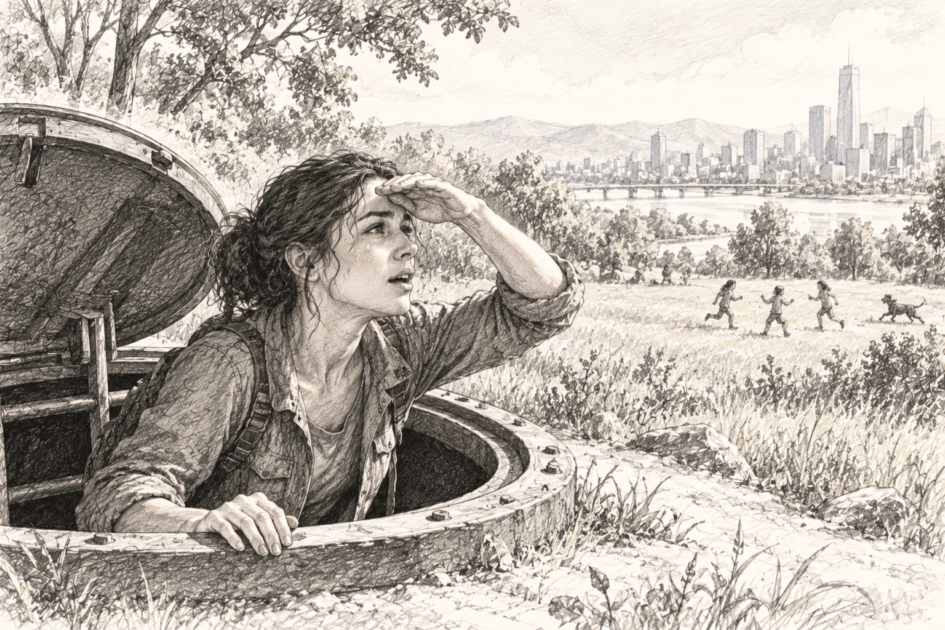
Light so bright it hurt blinded Isleen the moment the hatch was opened. With all her strength, she pushed the thick metal door open until it couldn’t move further. A harsh wind tore past her, whipping her hair across her face. She heaved herself over the ledge and realized in that moment that she could breathe.
Isleen blinked through the brightness to find a vast expanse of sprawling green. Behind her, she saw what she could only assume to be a city. People—people—were in the city. Machines moved along concrete pathways lined by structures rising high up into the sky. Children played in the grass: real, lush grass, not the artificial stuff from the silo. She couldn’t believe what she was seeing. A whole world existed above the silo, so vast she couldn’t see it all.
For the first time in months, Isleen laughed until her lungs burned.
Leave a Reply